
The “gold mines” of Kahului, 1899.
Cover Image: Masthead of Ka Nupepa Kuokoa published on September 8, 1899.
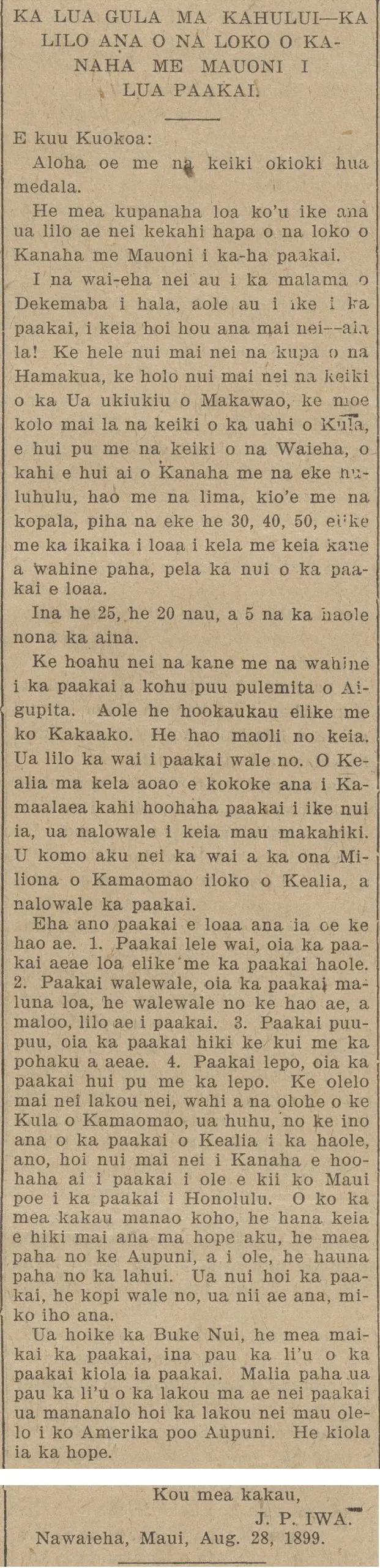
Image: Iwa, J. P. “Ka Lua Gula ma Kahului—Ka Lilo ana o na Loko o Kanaha me Mauoni i Lua Paakai.” Ka Nupepa Kuokoa, September 8, 1899, p.3.
THE GOLD MINES OF KAHULUI—KANAHĀ AND MAUONI PONDS TURN INTO GOLD MINES.
My dear Kuokoa:
Aloha to you and the boys who set the metal type.
It was something truly amazing for me to see, that a portion of the ponds of Kanahā and Mauoni had turned into salt fields.
I was in the lands of Nāwaiʻehā during the month of this past December and I did not see the salt, but this time when I returned—there it was! The natives of the Hāmākua districts are going in droves; the youths of the ʻŪkiukiu Rain of Makawao are running quickly; the youths of the smoke of Kula are creeping along to join with the youths of Nāwaiʻehā, and the place where they are gathering is at Kanahā, with gunny sacks. They scoop with their hands and shovels, and fill 30, 40, 50 bags, depending upon the strength of the man or perhaps the woman, and that is how much salt is to be had.
If you have 25 bags, 20 are for you and 5 for the haole to whom the land belongs.
The men and women are heaping up the salt and it looks like the pyramids of Egypt. They are not placing it like at Kakaʻako. They are actually scooping. The water turned into just salt. Keālia, the side approaching Kamaʻalaea, is a place well-known for gathering salt. These years it is no more. The water of the Millionaire of Kamaʻomaʻo1 has been drained into Keālia and there is no more salt.
There are four types of salt you get when scooping: 1. Paʻakai lele wai, that is the salt that is very fine like the salt of the haole. 2. Paʻakai walewale, that is the salt at the very top; it is very slimy when scooped, and when dried becomes salt. 3. Paʻakai puʻupuʻu, that is the salt that can be crushed with a rock until fine. 4. Paʻakai lepo, that is salt mixed with earth. They say that according to the ghosts of the Kamaʻomaʻo Plains, they are incensed because of the spoiling of the salt of Keālia by the haole. There are many going to Kanahā to make salt so that Maui’s people do not fetch their salt from Honolulu. In the opinion of the writer, this is something that will occur in the future: the government will stink, or the people will smell. There is a great amount of salt, to sprinkle, to encrust, to season.
The Good Book tells us that salt is good. But if the salt hath lost its savour, let it be cast. Perhaps their salt hath lost its savour and their words to the head of the American government have been softened. What follows is for them to be tossed.
. . . . . . . . .
Your writer,
J. P. Iwa.
Nāwaiʻehā, Maui, Aug. 28, 1899.
1Ka ʻona miliona o Kamaʻomaʻo, or the millionaire of Kamaʻomaʻo refers to Claus Spreckels.
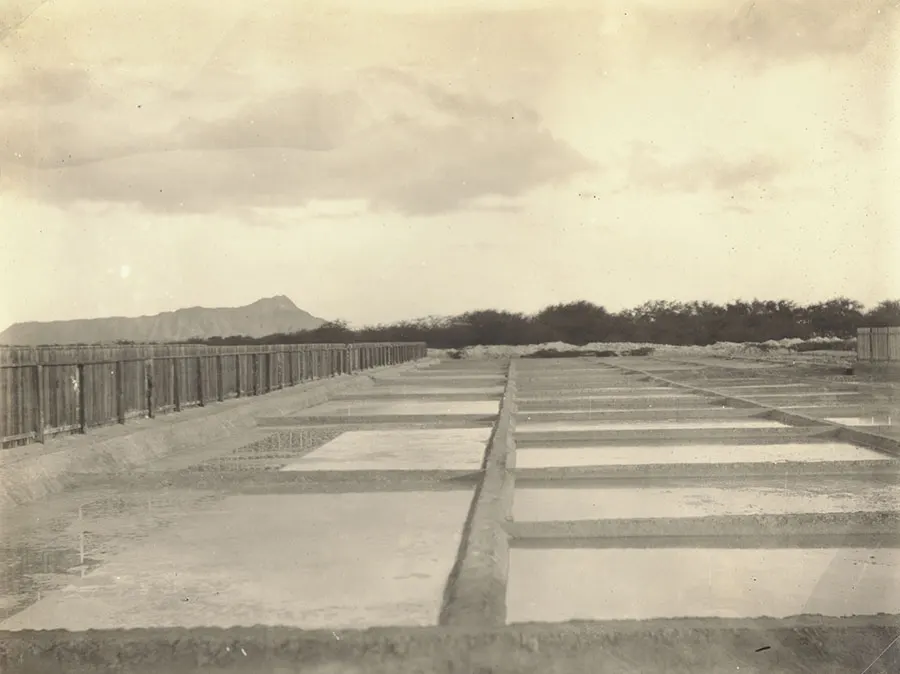
Image: Saltbasins, Kewalo Flats, Honolulu, Oʻahu, photo by Alonzo Gartley, ca. 1890. Bishop Museum Archives. SP 1101
Image sharing on social media is welcome. For all other uses please contact Archives@BishopMuseum.org
This post is part of He Aupuni Palapala: Preserving and Digitizing the Hawaiian Language Newspapers, a partnership between Bishop Museum and Awaiaulu with assistance from Kamehameha Schools. Mahalo nui loa to Hawaii Tourism Authority for their support. Learn more about this project here.
More from Ka Nupepa Kuokoa
See all →
Errors in Newspapers Corrected Quickly.
Whether a mistake in a newspaper is caught during production or after distribution, corrections could be made and publicized relatively quickly.
Library Week (April 19–25)
In celebration of Library Week, a story on Hoʻokena getting a reading room, and T. K. Robert Amalu’s clever words used to encourage donations.
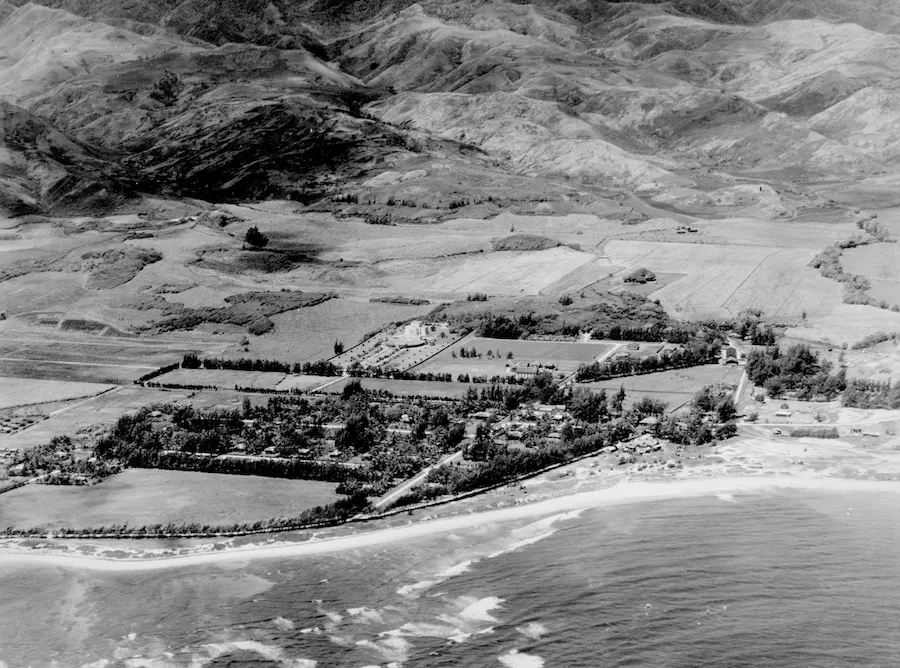
Bits of News from Lāʻie, Those Passed On and Kūlolo Peddled from Kauaʻi.
In many of the Hawaiian language newspapers, there was a column of short, random news items sent in by local correspondents: descriptions of neighborhood parties, extreme weather, fundraiser announcements, and so forth.
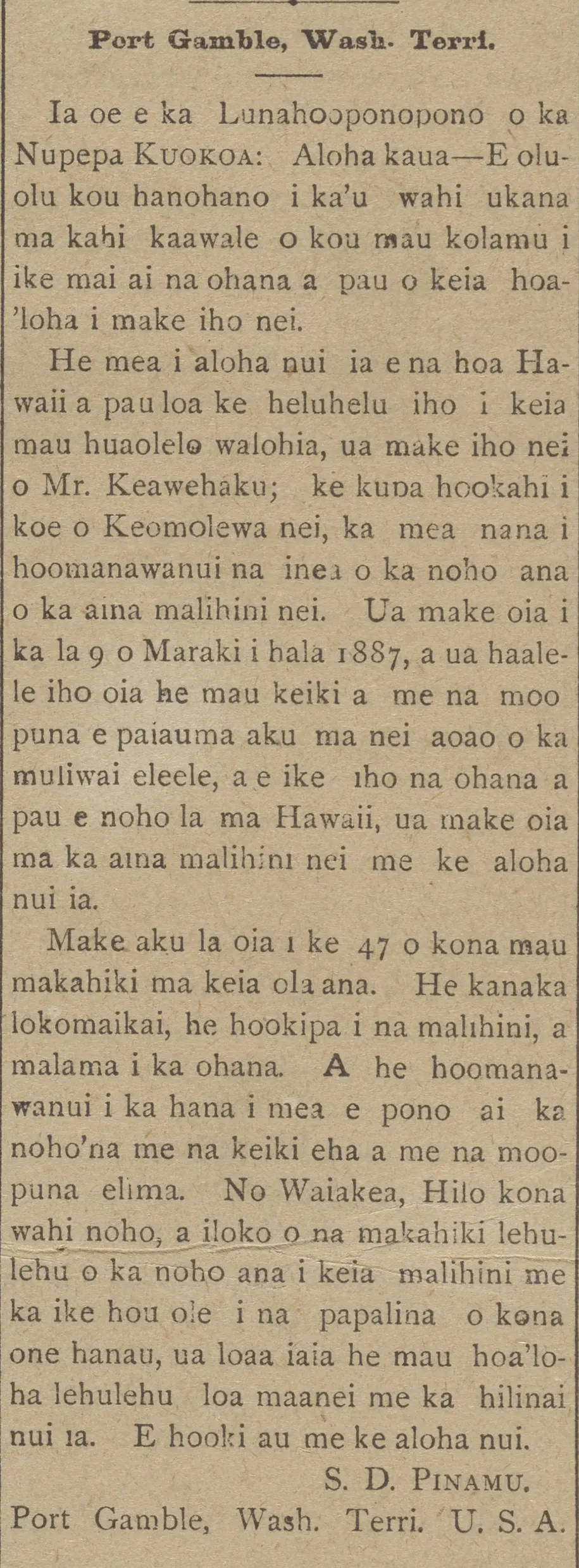
Sad tidings from faraway Washington Territory, 139 years ago.
People were not only subscribing to the Hawaiian newspapers here in Hawaiʻi nei, but from across the Pacific and beyond as well. The newspaper could spread information quickly, and it was the most efficient means to announce marriages, births, and deaths. Here, word of the passing of Mr. Keawehaku, a native of Waiākea Hilo and the only old-timer left in Keomolewa (Columbia River), reaches all over Hawaiʻi only a month later.