
Lā Kūʻokoʻa in the Territory of Hawaiʻi
Cover Image: Masthead of Ka Nupepa Kuokoa, printed on September 25, 1896.
Aloha Nūhou Monday!
The 28th of this month will mark the 183rd year since the events of Lā Kūʻokoʻa, a day to commemorate Timoteo Haʻalilio, Reverend William Richards, and their intercontinental journey to secure Hawaiian independence.
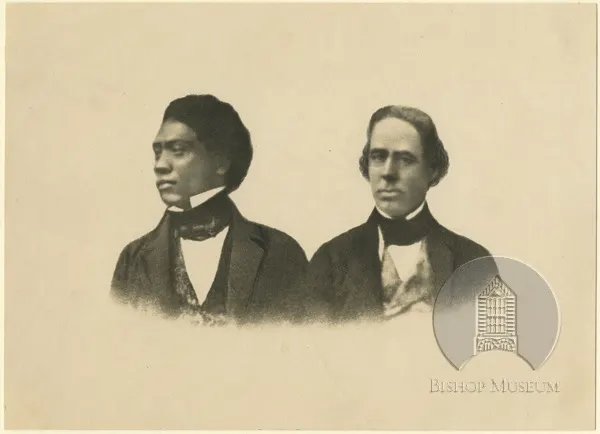
Image: Timoteo Haʻalilio (left) and William Richards (right); Paris, ca. 1843. Bishop Museum Archives, SP 18699.
Image sharing on social media is welcome. For all other uses please contact Archives@BishopMuseum.org
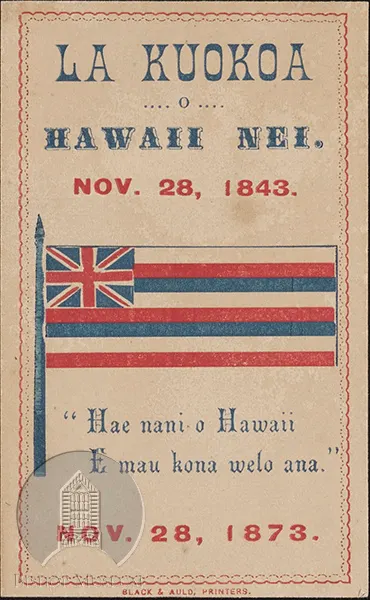
This ticket measuring 3½″ x 2⅛″ (8.7 cm x 5.4 cm) was printed in color by Black & Auld. It allowed entrance into the banquet commemorating Lā Kūʻokoʻa at Pohukaina. The text reads, “Independence Day of Hawaiʻi nei. Nov. 28, 1843. ‘Beautiful flag of Hawaiʻi, May it wave for all times.’ Nov. 18, 1873.” (MS Grp 70 Box 74.7.5.2)
Image sharing on social media is welcome. For all other uses please contact Archives@BishopMuseum.org
And while the day held great importance in the years immediately following, it wasn’t until 1847 that the Hawaiian Kingdom would recognize it as an official, national holiday. For 56 years, despite several changes in government, this day maintained the status accorded to it by Kamehameha III Kauikeaouli. In 1896 for example, under the Republic of Hawaiʻi, Lā Kūʻokoʻa was still recognized by the government that purported to have succeeded the monarchy.1
On April 28, 1903, then-territorial governor Sanford B. Dole approved Act 552—a bill introduced by Senator Dickey with the expressed purpose of amending the act which reaffirmed Lā Kūʻokoʻa’s status.3 Rather than ban the Hawaiian holiday outright, Act 55 simply announced all of the official holidays; unlike the years prior, “the twenty-eighth of November” was nowhere to be found. It was Dickey’s bill that formally ended Lā Kūʻokoʻa’s recognition in the eyes of Hawaiʻi’s government. A single asterisk removed in the following year’s 1904 publication of Thrum’s Hawaiian Almanac and Annual had marked the end of its legal recognition as a holiday. Despite this, it continued to be listed among the other celebrated holidays.
Though the public celebrations have dwindled over the years since, thanks to the efforts of many, Lā Kūʻokoʻa is now celebrated archipelago-wide.
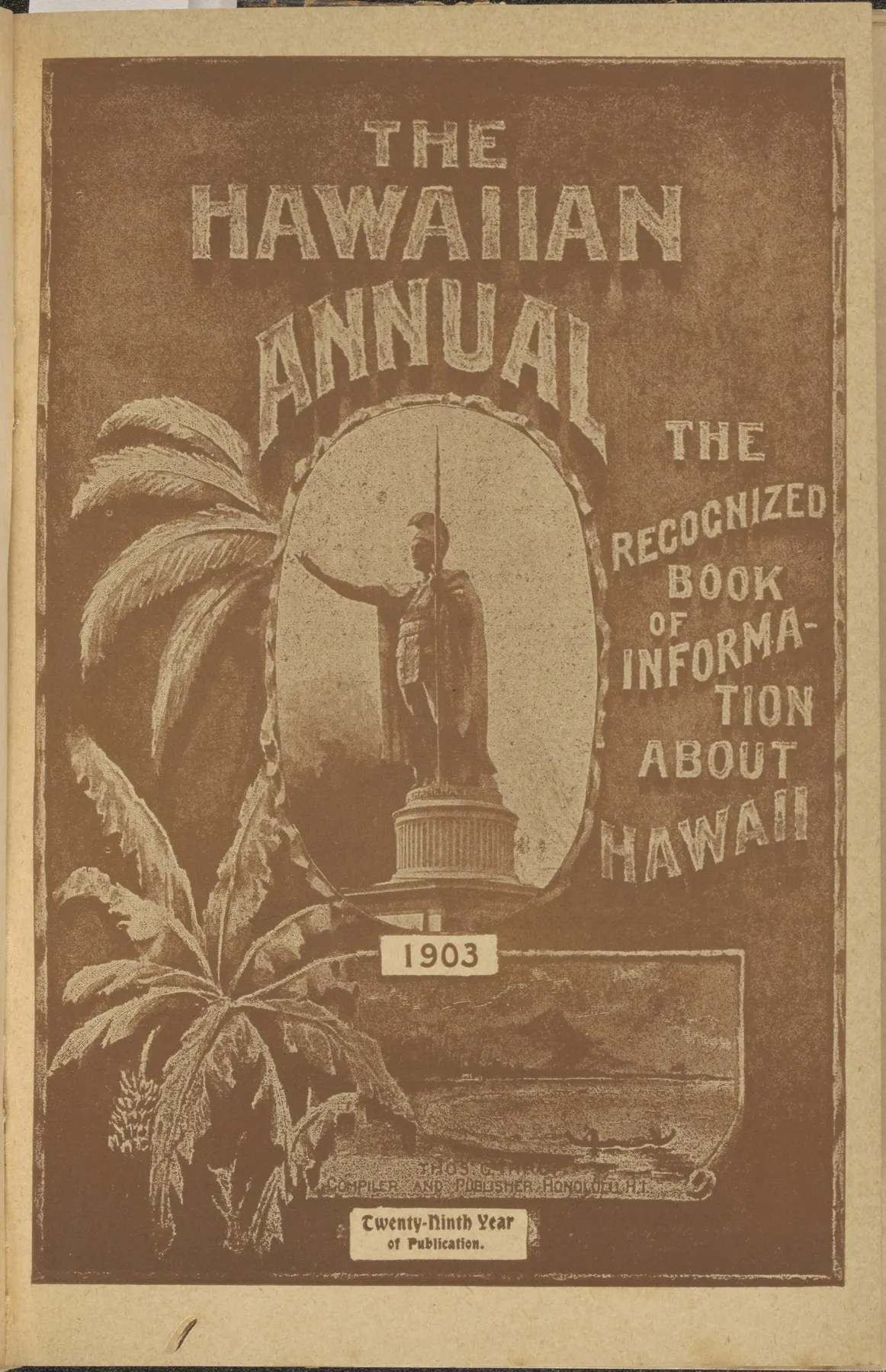
Image: Cover of Thomas G. Thrum’s, Hawaiian Almanac and Annual for 1903.
Image sharing on social media is welcome. For all other uses please contact Archives@BishopMuseum.org
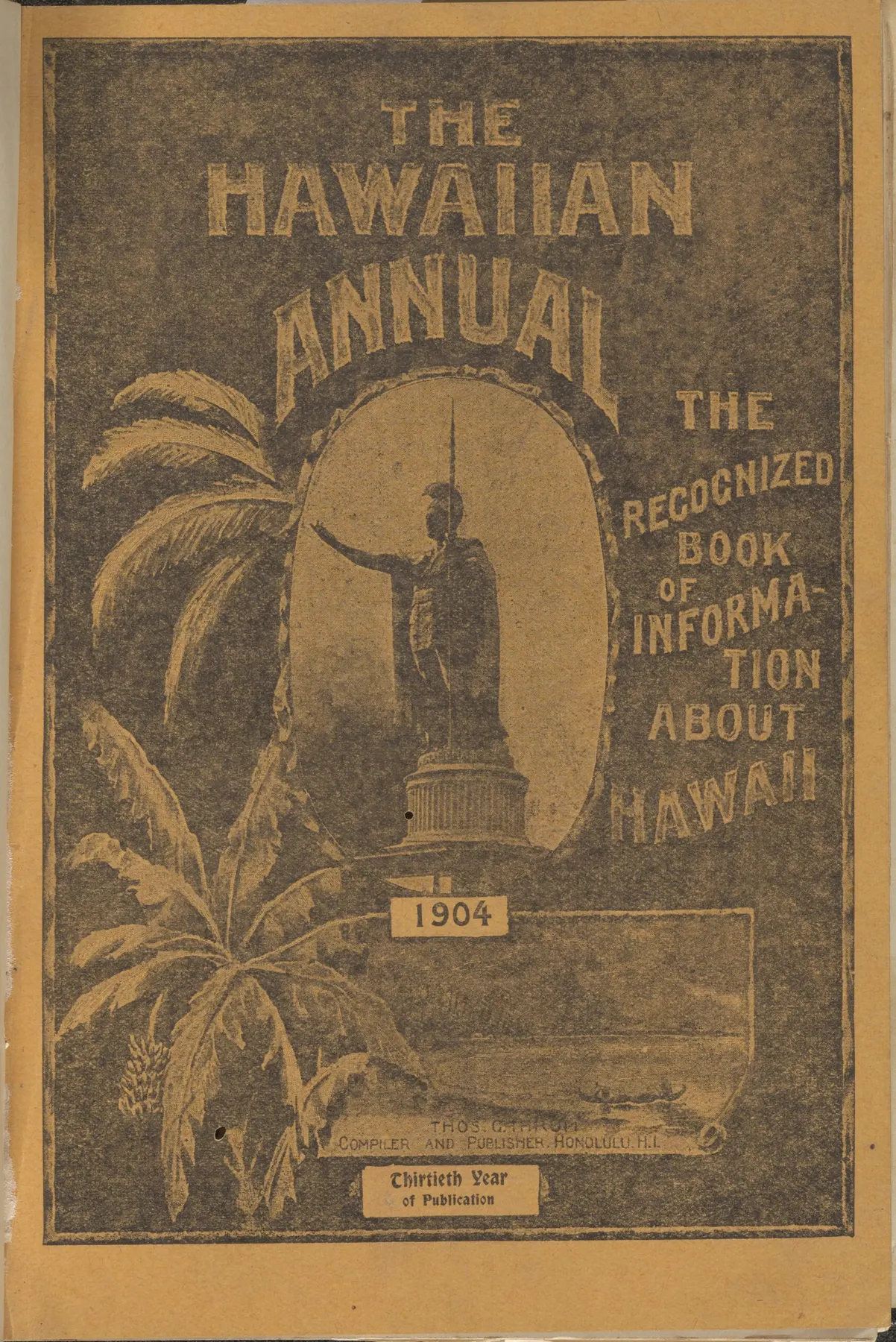
Image: Cover of Thomas G. Thrum’s, Hawaiian Almanac and Annual for 1904.
Image sharing on social media is welcome. For all other uses please contact Archives@BishopMuseum.org
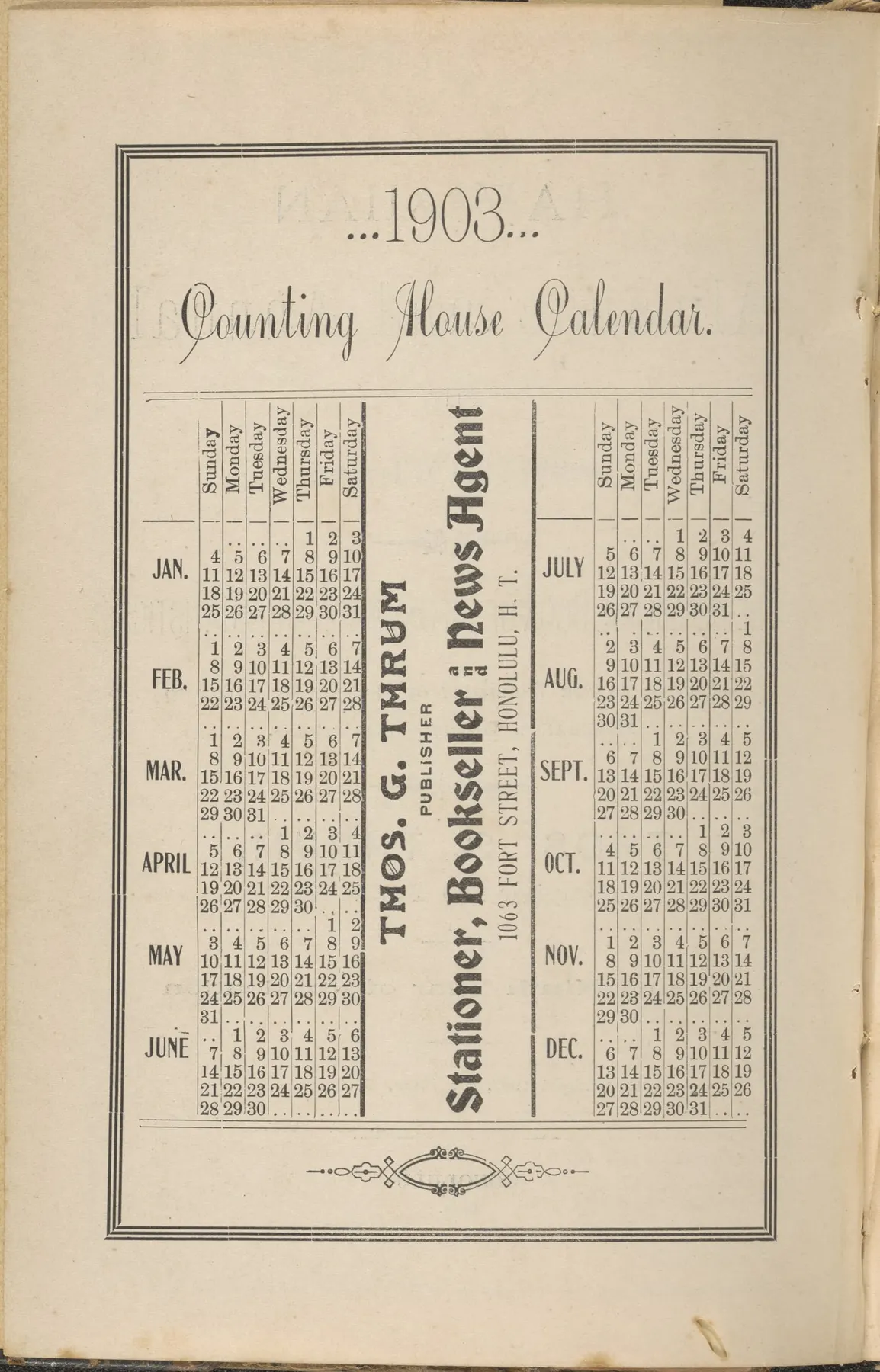
Image: “1903 Counting House Calendar.” Thomas G. Thrum, Hawaiian Almanac and Annual for 1903, p. 2.
Image sharing on social media is welcome. For all other uses please contact Archives@BishopMuseum.org
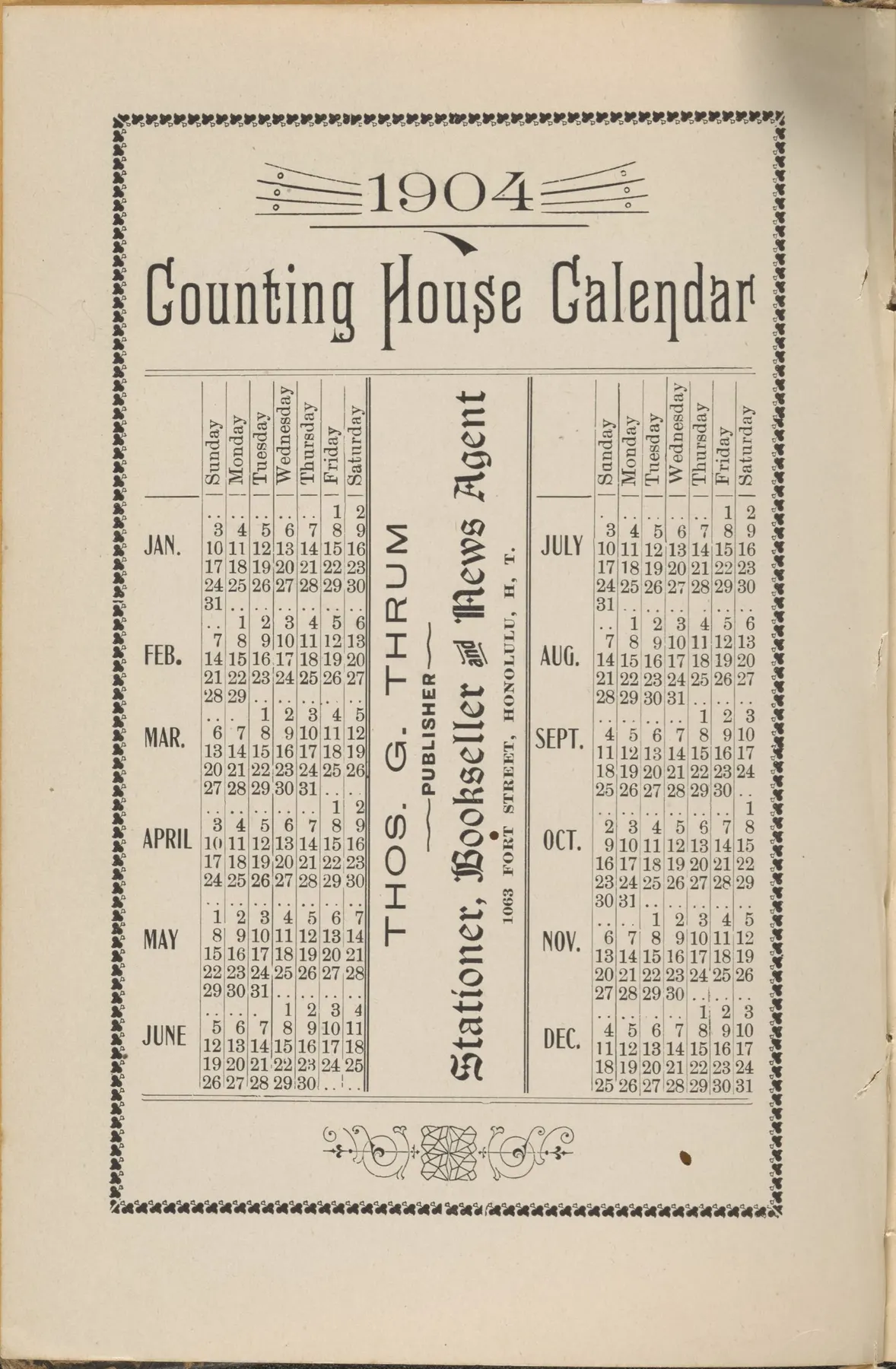
Image: “1904 Counting House Calendar.” Thomas G. Thrum, Hawaiian Almanac and Annual for 1903, p. 2.
Image sharing on social media is welcome. For all other uses please contact Archives@BishopMuseum.org
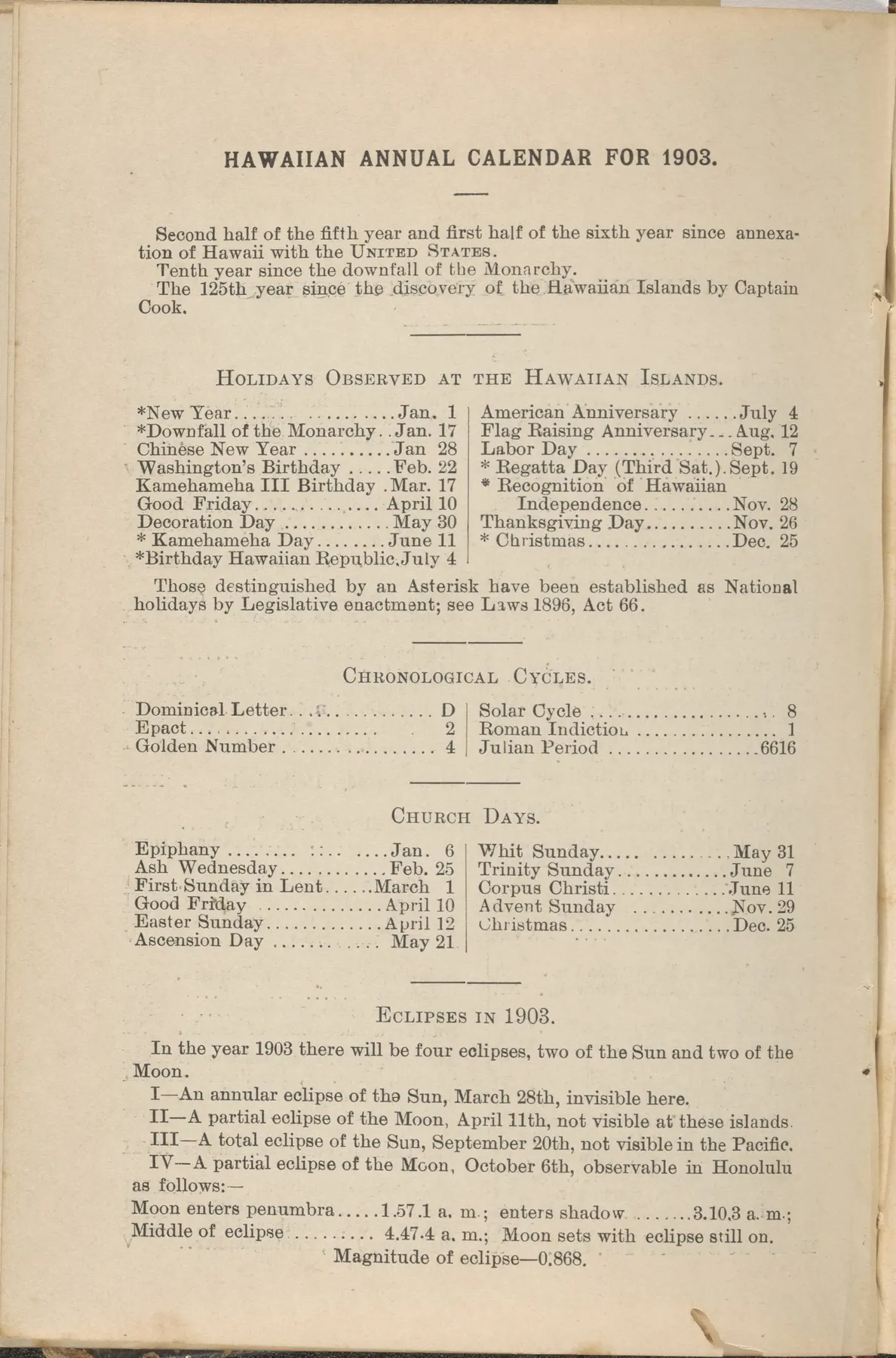
Image: “Hawaiian Annual Calendar for 1903.” Thomas G. Thrum, Hawaiian Almanac and Annual for 1903, p. 6.
Image sharing on social media is welcome. For all other uses please contact Archives@BishopMuseum.org
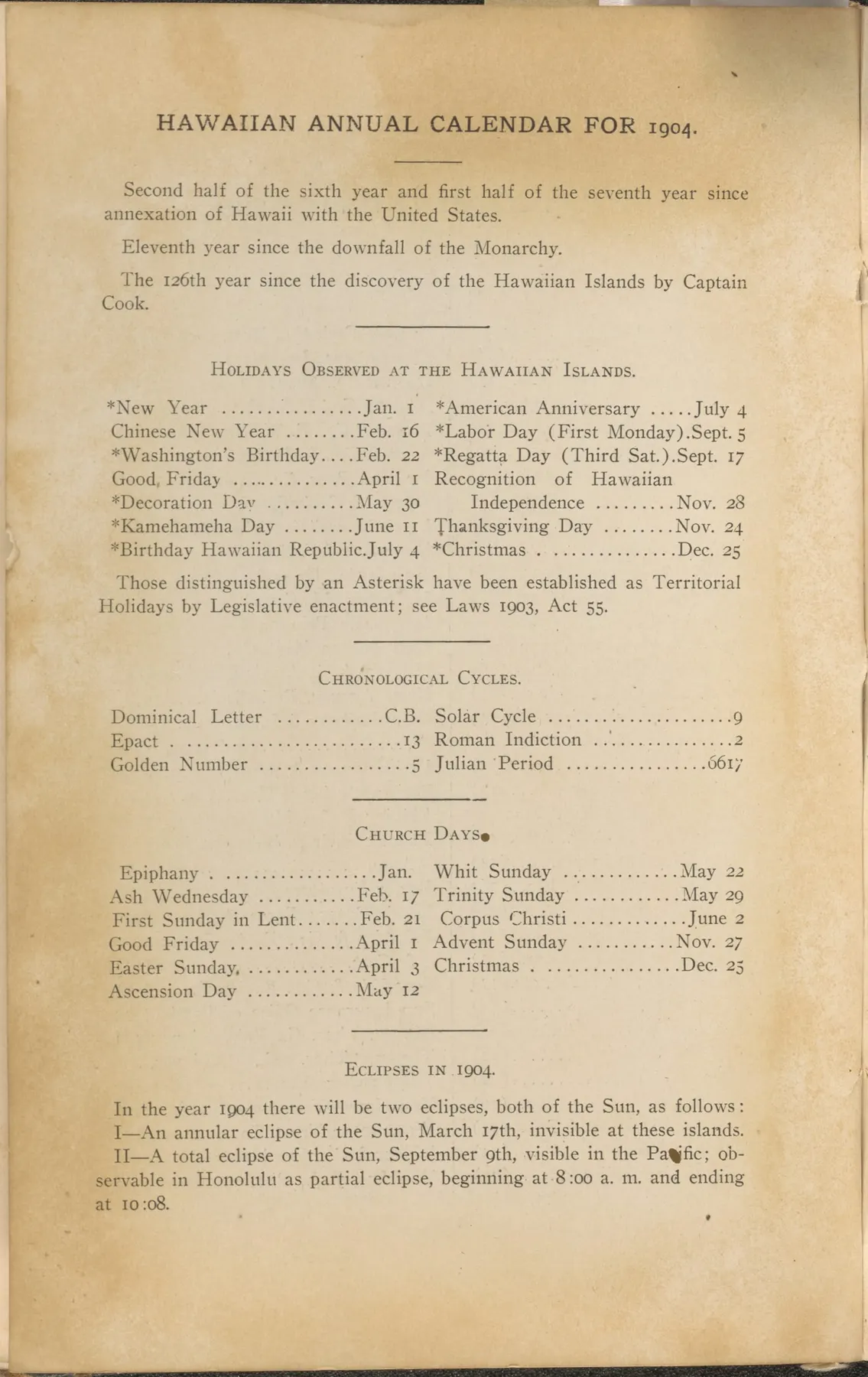
Image: “Hawaiian Annual Calendar for 1904.” Thomas G. Thrum, Hawaiian Almanac and Annual for 1904, p. 4.
Image sharing on social media is welcome. For all other uses please contact Archives@BishopMuseum.org
1 Act 66, Laws of the Republic of Hawaii, 1896.
2 Act 55, Laws of the Territory of Hawaii, 1903, pp. 278–279.
3 See “Na Hana o ka Ahaolelo,” Ka Nupepa Kuokoa, February 27, 1903, p. 5.
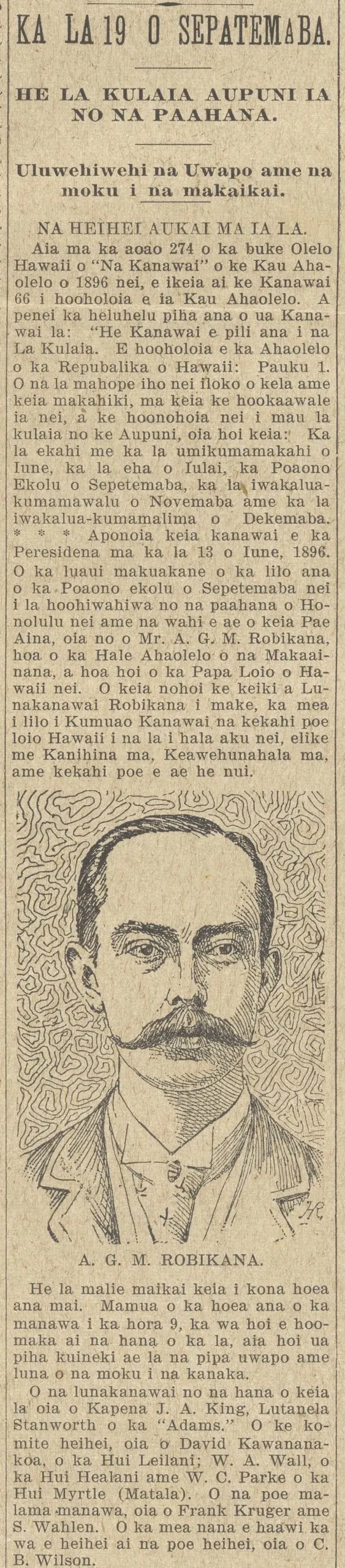
Image: Excerpt from “Ka La 19 o Sepatemaba.” Ka Nupepa Kuokoa, September 25, 1896, p. 2.
THE 19TH OF SEPTEMBER.
A NATIONAL HOLIDAY FOR THE WORKERS.
The Wharves and Ships Crowded with Sightseers.
THE BOAT RACES ON THAT DAY.
It’s on page 274 of the Hawaiian-language book of “Laws” for the 1896 Legislative Session where one will find Act 66, passed by that Session. Here is the complete reading of that bill: An Act Relating to Holidays. Be it enacted by the Legislature of the Republic of Hawaiʻi: Section 1. The following days of each year are hereby set apart and established as national holidays, to wit: The first and the eleventh day of June,4 the fourth of July, the third Saturday of September, the twenty-eighth of November, and the twenty-fifth of December. * * * This law was approved by the President on the 13th day of June, 1896.”5
4 The English text of Act 66 reads “The first and seventeenth days of January, the eleventh day of June.”
5 The English text of Act 66 gives the date of approval as June 18, 1896.
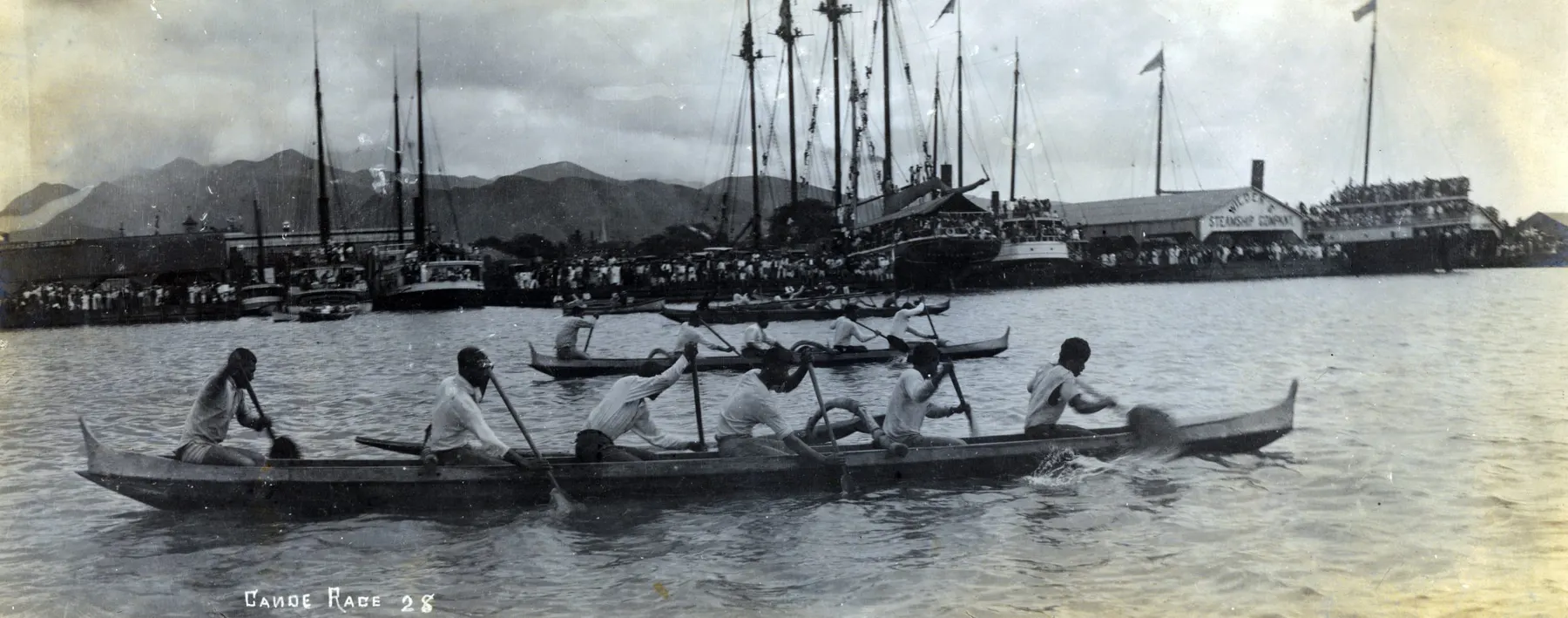
Image: Canoe Race in Honolulu Harbor; Oʻahu, Hawaiʻi, ca. 1900. Bishop Museum Archives, SP 38242.
Image sharing on social media is welcome. For all other uses please contact Archives@BishopMuseum.org

Image: Excerpt from “La Heihei Waapa.” Ka Nupepa Kuokoa, September 15, 1905, p. 2.
REGATTA DAY.
This is not the first time this kind of attraction has been put on, being that boat racing’s been a fascination of our people here in Hawaiʻi from the very beginning, and this manner of attraction is equally as in demand by the people of this town. Yet, in the eyes of the law in Hawaiʻi, this regatta day was [only just] added to the Territory of Hawaiʻi’s list of holidays, as passed on April 28, 1903, Act 55 of the 1903 Legislature—signed by S. B. Dole, Governor of the Territory of Hawaiʻi in those days.
This act, identified above by the number 55, is an amendment to Act 66 of the Session Laws of 1896, of the Territory of Hawaiʻi [sic],6 reiterating the holidays of Hawaiʻi to be celebrated as those times come around each year, as follows: New Year, January 1; February 22, the birthday of President Washington; May 30, Decoration Day; June 11, the birthday of Kamehameha I, the Conqueror; July 4, the independence day of the United States of America; the workers’ holiday, the first Monday of September; regatta day, the third Saturday of September; and the birthday of the Lord Jesus Christ, Christmas, December 25.
This post is part of He Aupuni Palapala: Preserving and Digitizing the Hawaiian Language Newspapers, a partnership between Bishop Museum and Awaiaulu with assistance from Kamehameha Schools. Mahalo nui loa to Hawaii Tourism Authority for their support. Learn more about this project here.
More from Ka Nupepa Kuokoa
See all →
Nohouō o luhuna, Nohouō o lahalō…
The title above is the opening of the famous words by Kamehameha III cloaked in kake, reassuring Kalama that she had nothing to fear by meeting him in his royal residence of Kahaleuluhe.
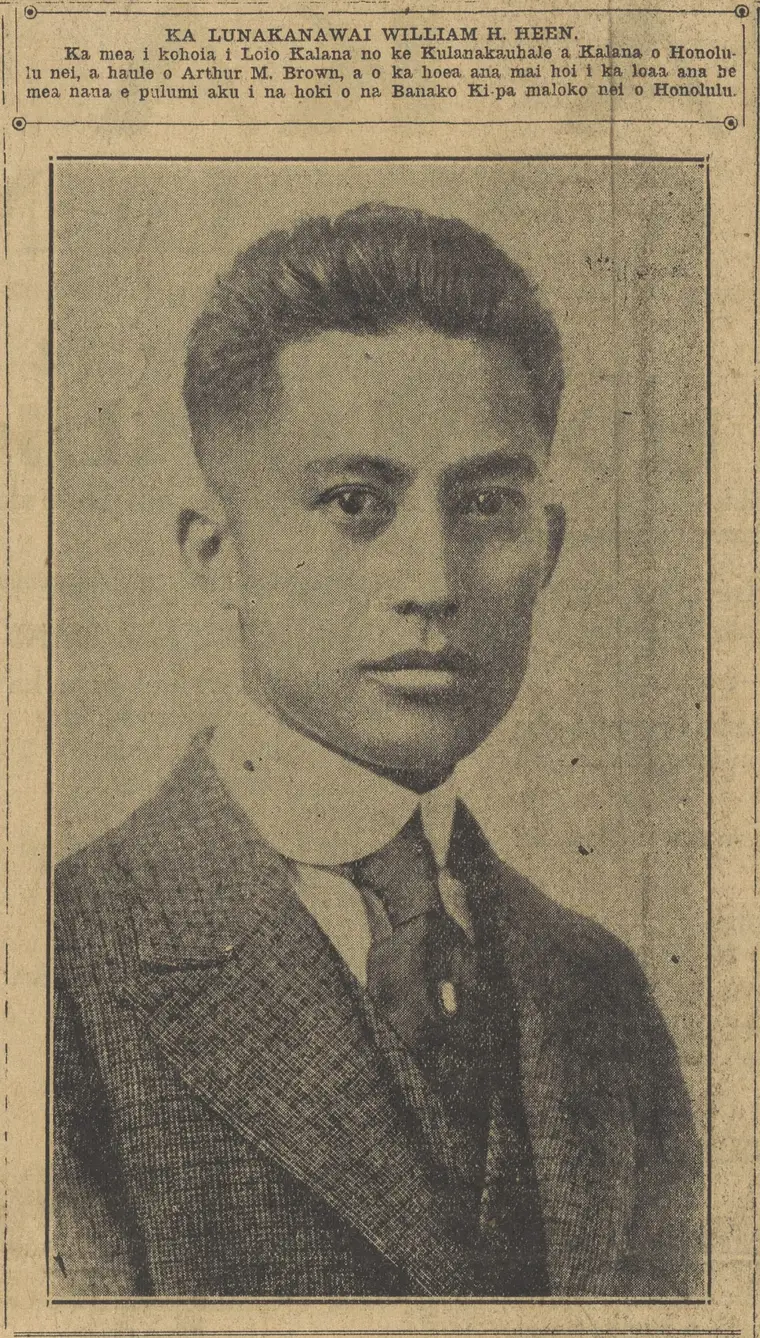
Campaign mele for William Heen
Election time is upon us once again. While we still see sign waving and posters hung in shop windows and on the next-door neighbor’s fence, campaign mele have all but disappeared.
What was black and green and read all over?
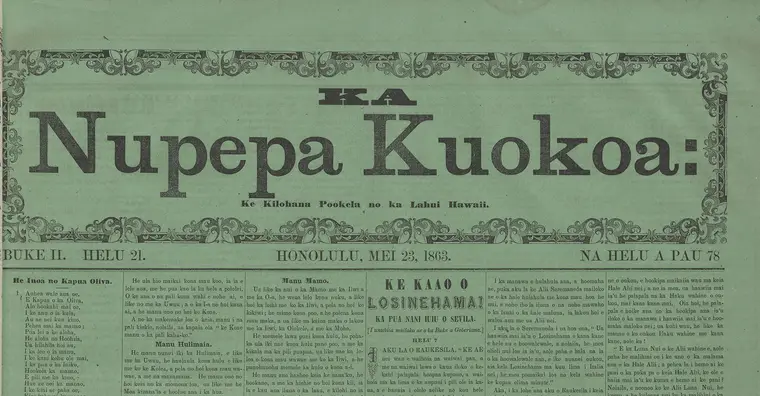
The answer to the riddle above is the Kuokoa of May 23, 1863.
Rules for Writing to the Newspaper
The newspaper business was difficult enough without having to worry about people following the basic rules for submissions to be published.