
Nohouō o luhuna, Nohouō o lahalō...
Cover Image: Masthead of Ka Nuhou Hawaii, printed on November 25, 1873.
Aloha Nūhou Monday!
The title above is the opening of the famous words by Kamehameha III cloaked in kake,1 reassuring Kalama that she had nothing to fear by meeting him in his royal residence of Kahaleuluhe.
Ka Lama Hawaii criticized the use of kake and other means of disguising what you are saying.
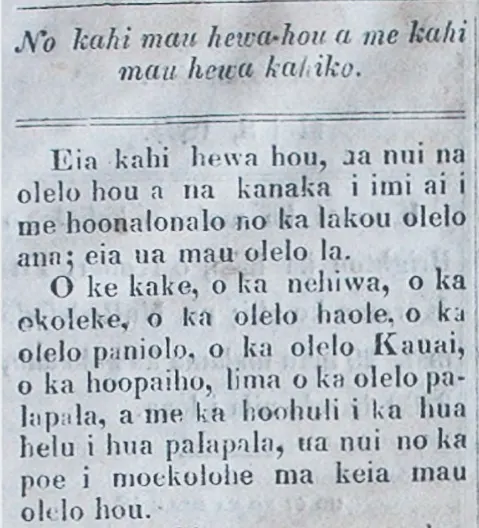
Image: Excerpt from “No kahi mau hewa hou a me kahi mau hewa kahiko.” Ka Lama Hawaii, May 9, 1834, p. 4.
Pertaining to some new vices and some old vices.
This is a new vice; there are many new languages by which people use to hide what they are trying to say; these are those languages.
Kake, nehiwa, ʻokolekē, English, Spanish, Kauaʻi speech, making hand-signs of written words, and the changing of numbers into letters…
Almost 20 years later, Joseph P. Iwa also criticized the use of kake and gives a sample of kake and its translation in, “He Aha la ke Kumu i Hookahuli ai Kekahi Poe i ka Olelo Hawaii?” Ka Nupepa Kuokoa, May 2, 1863.
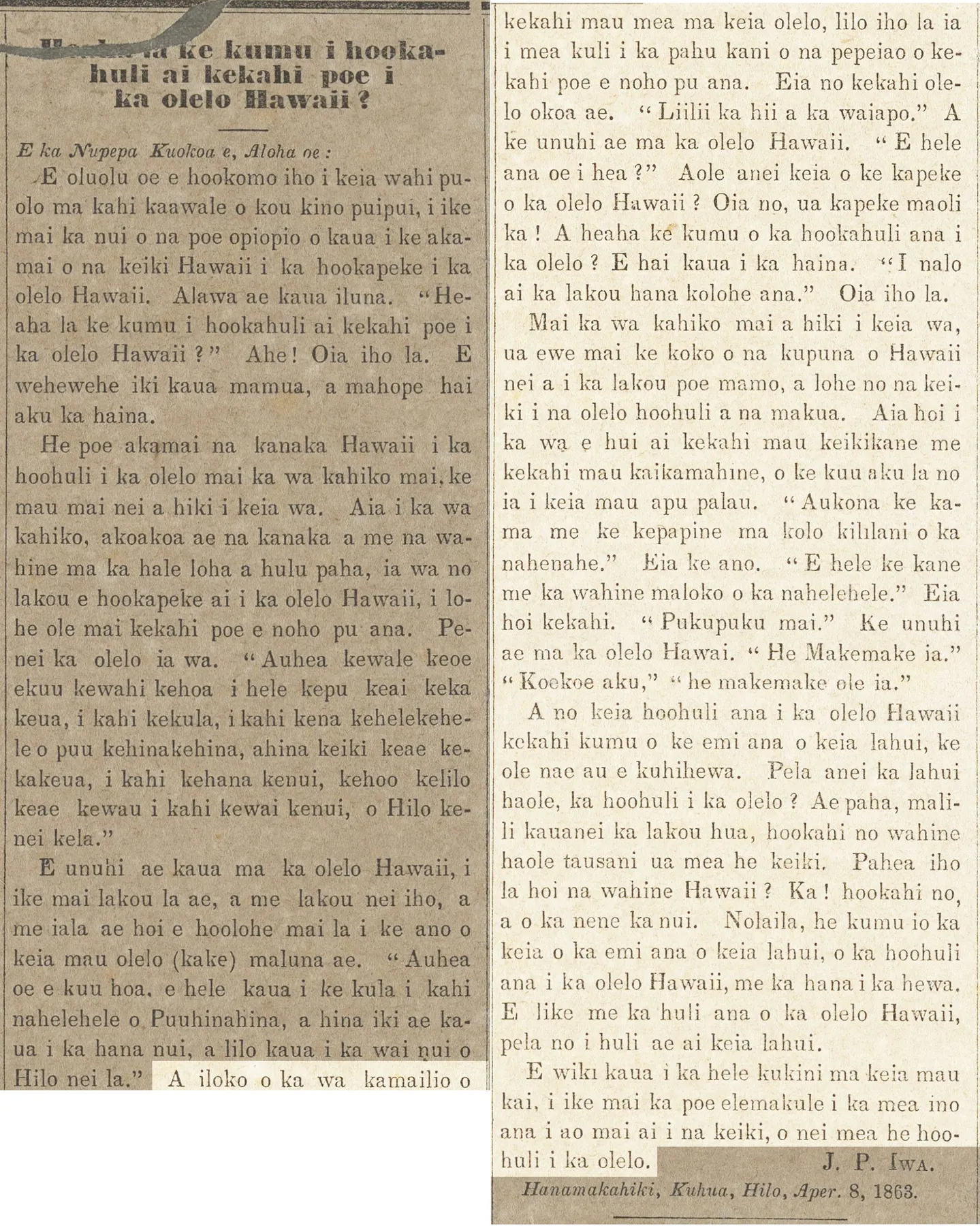
Image: J. P. Iwa, “Heaha la ke kumu i hookahuli ai kekahi poe i ka olelo Hawaii?” Ka Nupepa Kuokoa, May 2, 1863, p. 4.
Why do some people change the Hawaiian language?
O Kuokoa Newspaper, Aloha oe:
Please insert this pūʻolo in a free space of your stout body so that all of our children will see the skill of the Hawaiian youths at changing the Hawaiian language. Let us take a look above. “Why do some people change the Hawaiian language?” Ah! That is it. We will explain a bit first and follow up with the answer.
Hawaiians were skilled at alter the language from old times; this continues to this day. In the old days, men and women used to gather in a loha (kilu) house or perhaps a [hula] house, and this was when they would alter the Hawaiian language so that people around them would not hear. They spoke like this in those times: “Auhea kewale keoe ekuu kewahi kehoa i hele kepu keai keka keua, i kahi kekula, i kahi kena kehelekehele o puu kehinakehina, ahina keiki keae kekakeua, i kahi kehana kenui, kehoo kelilo keae kewau i kahi kewai kenui, o Hilo kenei kela.”
Let’s translate it into the Hawaiian language so those over there will know, and those over here, as well as that one, listening to the nature of this language (kake) above: “Auhea oe e kuu hoa, e hele kaua i ke kula i kahi nahelehele o Puuhinahina, a hina iki ae kaua i ka hana nui, a lilo kaua I ka wai nui o Hilo nei la.”
…
J. P. Iwa,
Hanamakahiki, Kuhua, Hilo, April 8, 1863. 2
1According to the Pukui/Elbert dictionary kake were: Chants with mixed or garbled words, for and by chiefs, with inserted syllables and some secret words.
2More than ten years later, on February 3, 1876, Iwa sends in a similar article to Ka Lahui Hawaii. It was titled, “Heaha la ke kumu o ka Hookapeke ana o kekahi poe ma ka Olelo Hawaii?”
The following are three mele kake that appear in Ka Nuhou Hawaii. Can you decipher them?
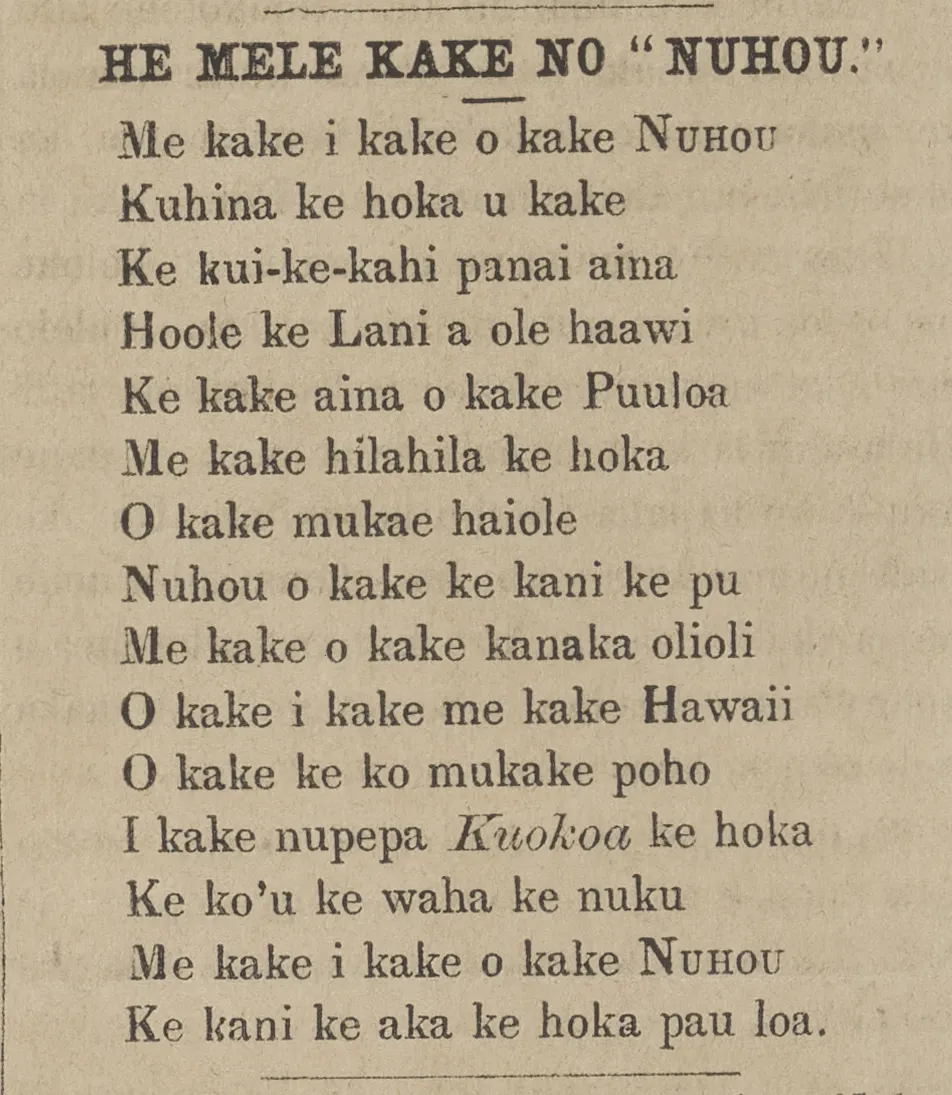
Image: “He Mele Kake no ‘Nuhou.’” Ka Nuhou Hawaii, November 25, 1873, p. 5.
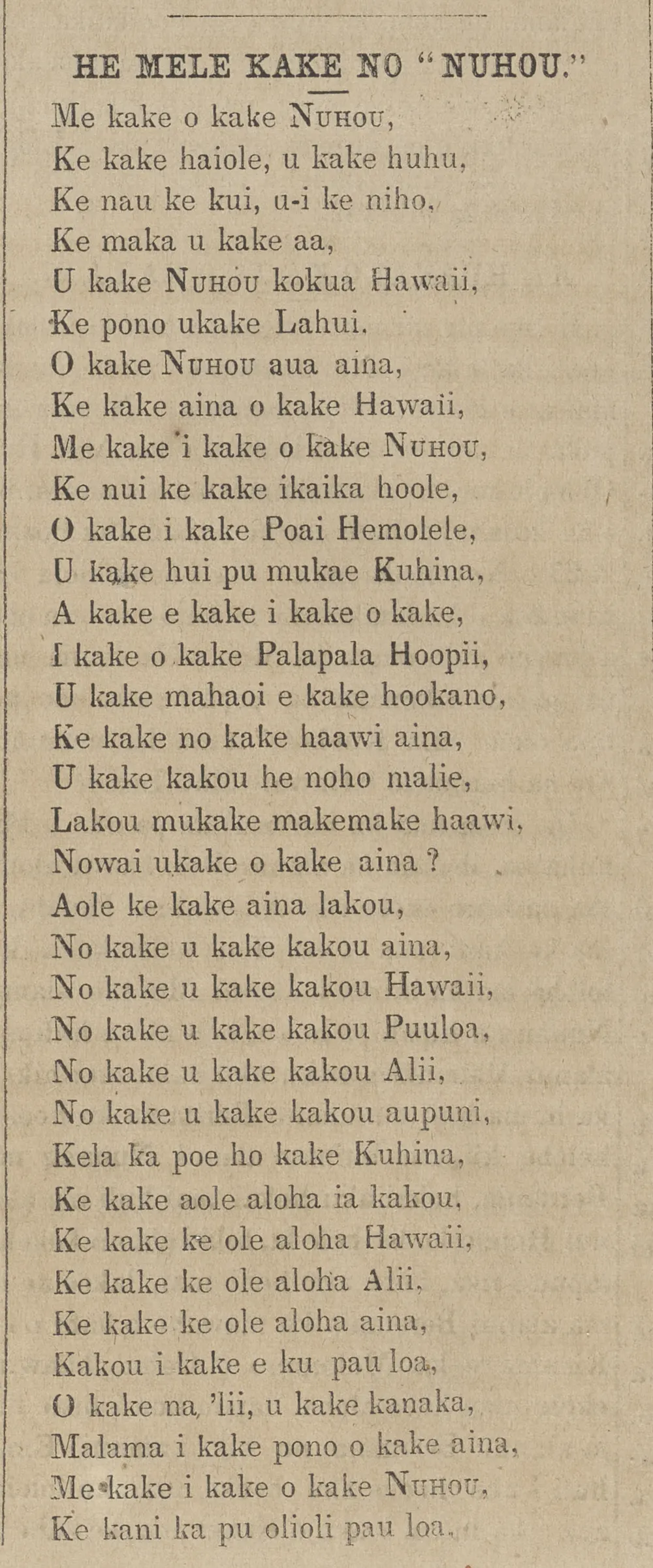
Image: “He Mele Kake no ‘Nuhou.’” Ka Nuhou Hawaii, December 2, 1873, p. 3.
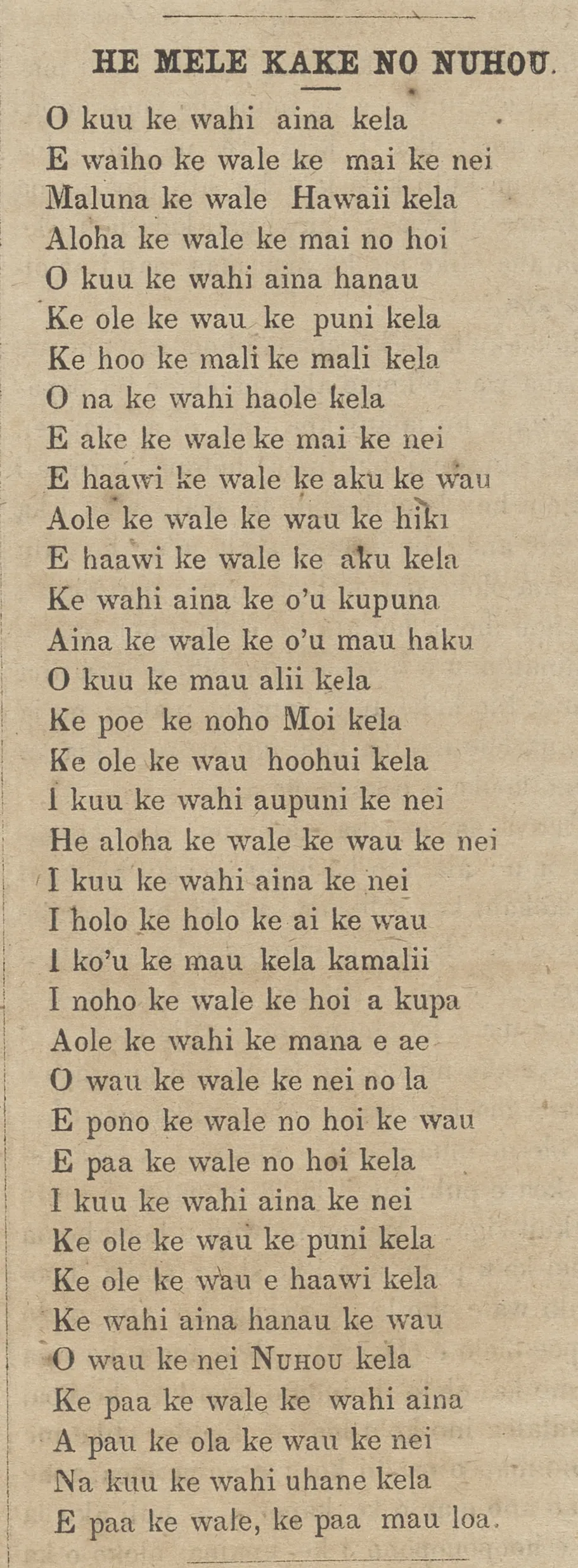
Image: “He Mele Kake no Nuhou.” Ka Nuhou Hawaii, December 30, 1873, p. 6.
This post is part of He Aupuni Palapala: Preserving and Digitizing the Hawaiian Language Newspapers, a partnership between Bishop Museum and Awaiaulu with assistance from Kamehameha Schools. Mahalo nui loa to Hawaii Tourism Authority for their support. Learn more about this project here.
More from Ka Nupepa Kuokoa
See all →
Lā Kūʻokoʻa in the Territory of Hawaiʻi
After more than half a century as a national holiday, a 1903 bill removed Lā Kūʻokoʻa’s official status as a holiday recognized by Hawaiʻi’s government.
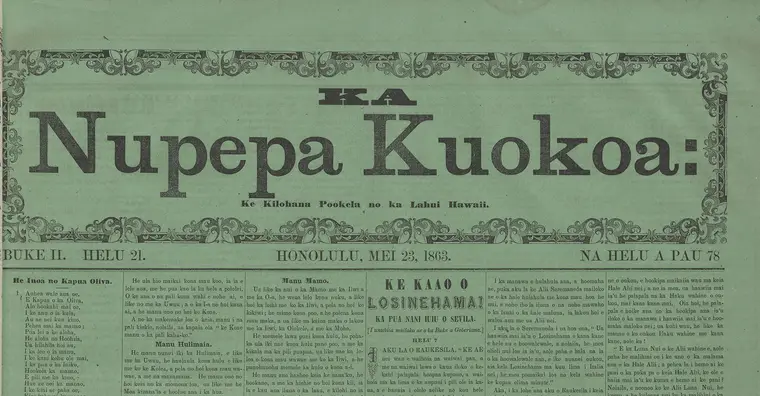
What was black and green and read all over?
The answer to the riddle above is the Kuokoa of May 23, 1863.
Rules for Writing to the Newspaper
The newspaper business was difficult enough without having to worry about people following the basic rules for submissions to be published.
Abbreviations
How do you save space, time, and money? One way the Hawaiian language newspapers accomplished this was by using abbreviations.